LET'S COOK
Helps people who are new to cooking to solve the tedious problems of the cooking process.
Role
Product Designer
Duration
June 2023-October 2023
Tools
Figma, Illustrator
Research:
Insights Synthesis:
Insights Synthesis:
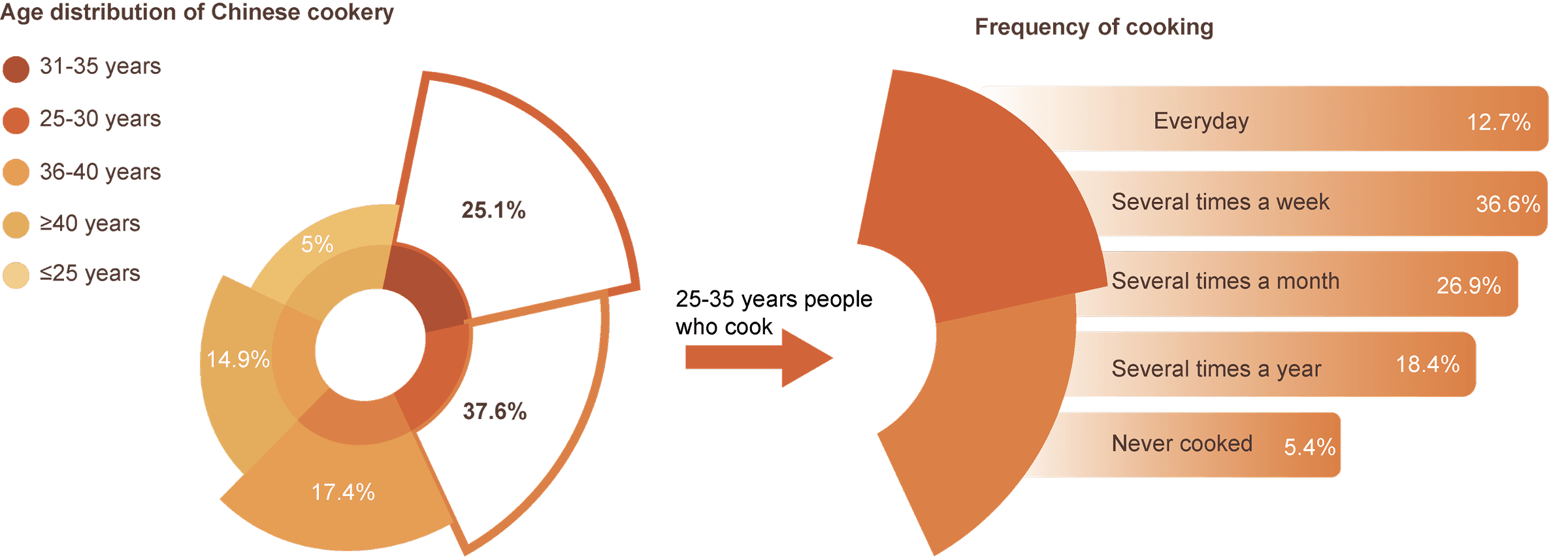
1. Cooking Is Becoming Younger and More Lifestyle-Driven
1. Cooking Is Becoming Younger and More Lifestyle-Driven
Cooking is no longer perceived purely as a way to save money or fulfill family obligations.
For younger users, it increasingly represents:
A form of health management
A way to regulate emotions and reduce stress
A daily ritual that adds meaning and structure to everyday life
Cooking is no longer perceived purely as a way to save money or fulfill family obligations.
For younger users, it increasingly represents:
A form of health management
A way to regulate emotions and reduce stress
A daily ritual that adds meaning and structure to everyday life
2. Frequent but Not Heavy Users → Strong Dependence on Low Barriers
2. Frequent but Not Heavy Users → Strong Dependence on Low Barriers
Cooking is no longer perceived purely as a way to save money or fulfill family obligations.
For younger users, it increasingly represents:
A form of health management
A way to regulate emotions and reduce stress
A daily ritual that adds meaning and structure to everyday life
Cooking is no longer perceived purely as a way to save money or fulfill family obligations.
For younger users, it increasingly represents:
A form of health management
A way to regulate emotions and reduce stress
A daily ritual that adds meaning and structure to everyday life
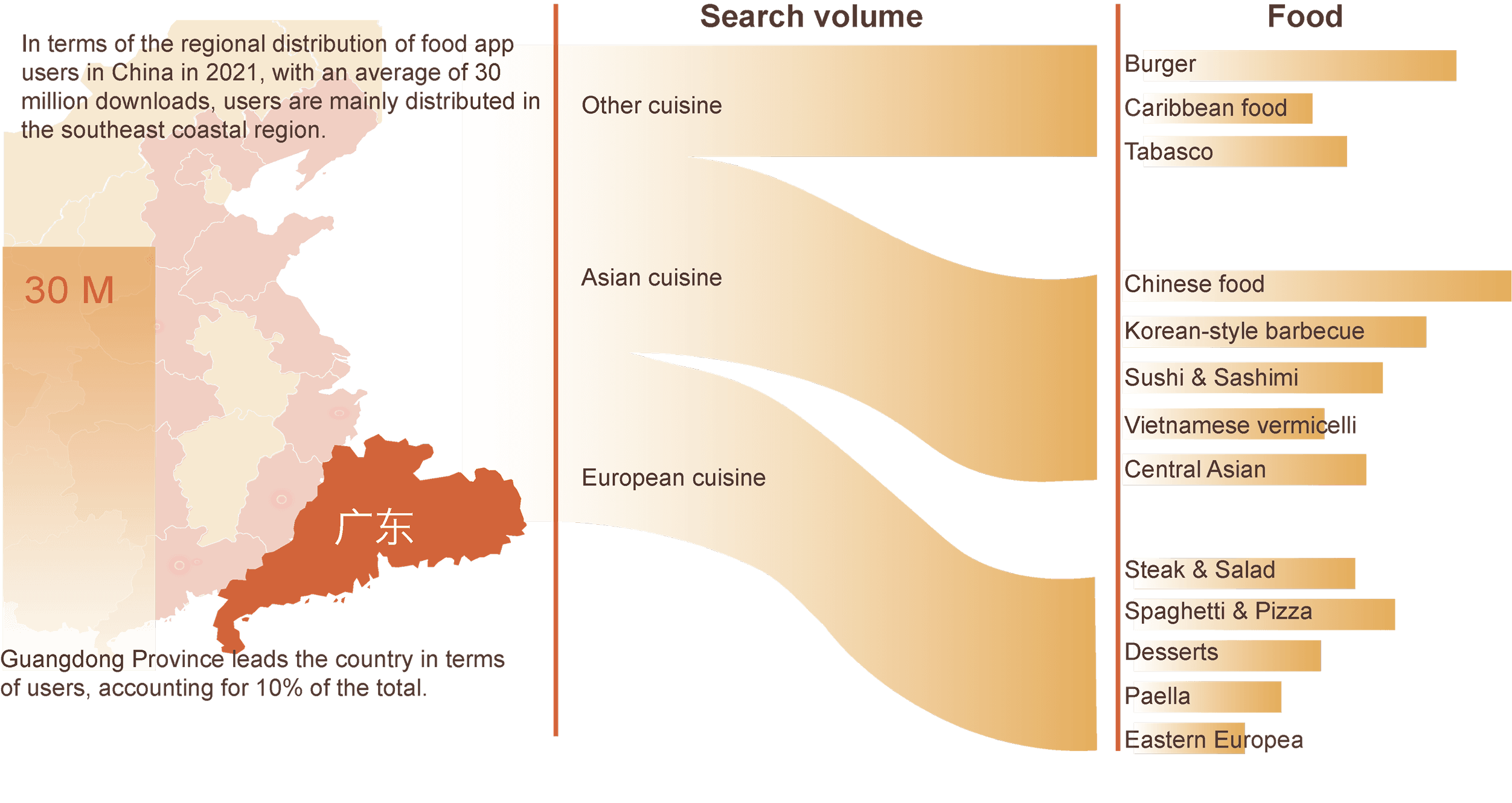
3. Content Preference: Familiar Foods with Light Global Exploration
3. Content Preference: Familiar Foods with Light Global Exploration
Users are not aiming for professional or chef-level cooking
Instead, their core question is:
“Can I finish this within 30 minutes tonight?”
Users are not aiming for professional or chef-level cooking
Instead, their core question is:
“Can I finish this within 30 minutes tonight?”
User interview:
Timeline
1 week
The user interview process lasts for one week. During this time period, we were able to collect data from multiple user sessions, which allowed us to collect a variety of user interview results and question scenarios.
Sample Size
20 people
We interviewed 20 participants for the study from commuters living alone, college students, young couples, and new parents.
“Fear of doing it wrong and lack of confidence”
“The fire is not well controlled and you are not sure if you are doing it right.”
“Wondering what I can cook with these at home.”.
Approach
20 sessions
To evaluate core features—recipe steps, AI support, comments, and Q&A—I ran structured usability sessions combining live observation and interviews.
These helped surface key pain points, expectations, and emotional responses.
I also followed up with select users after extended use to gather deeper insights on long-term engagement.
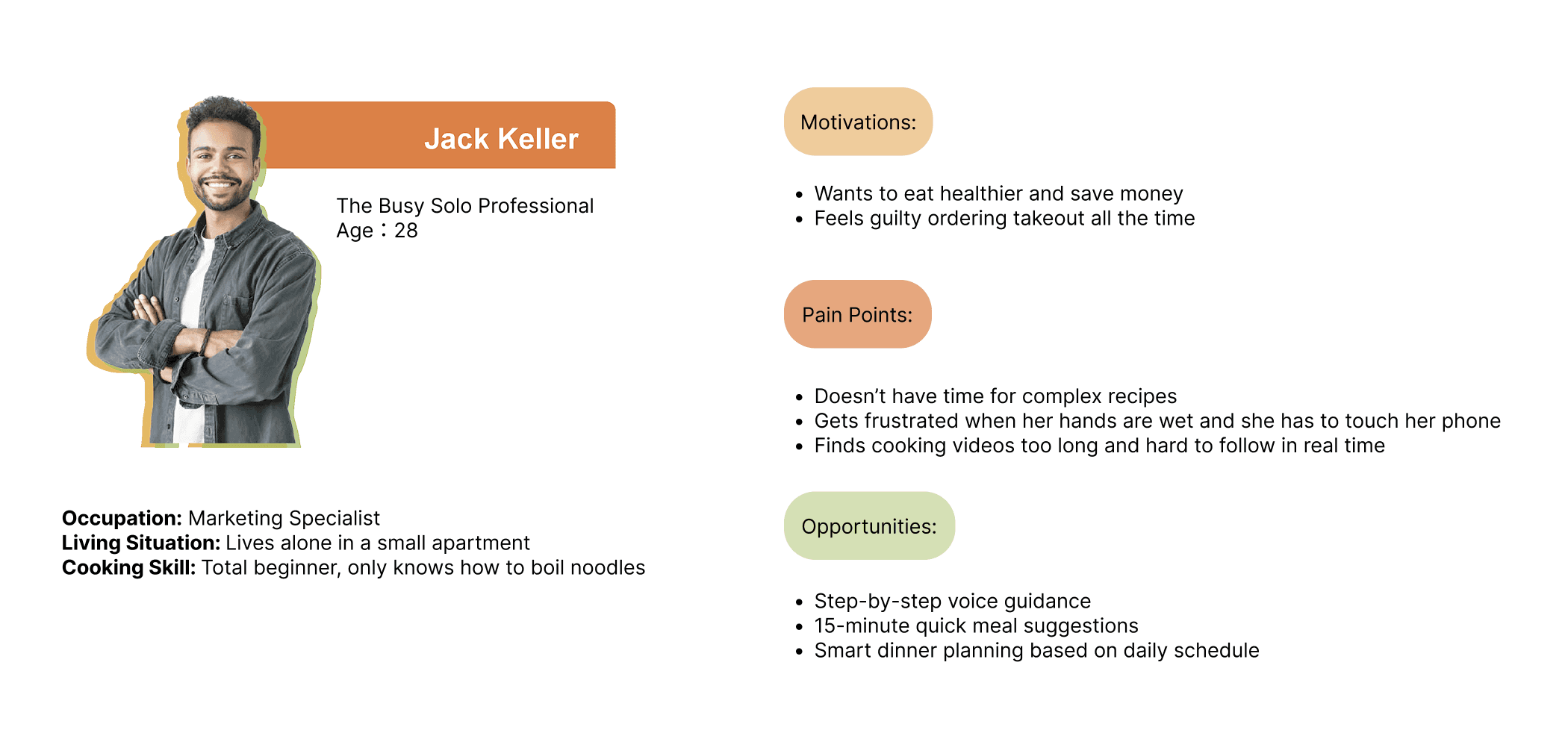
Persona:
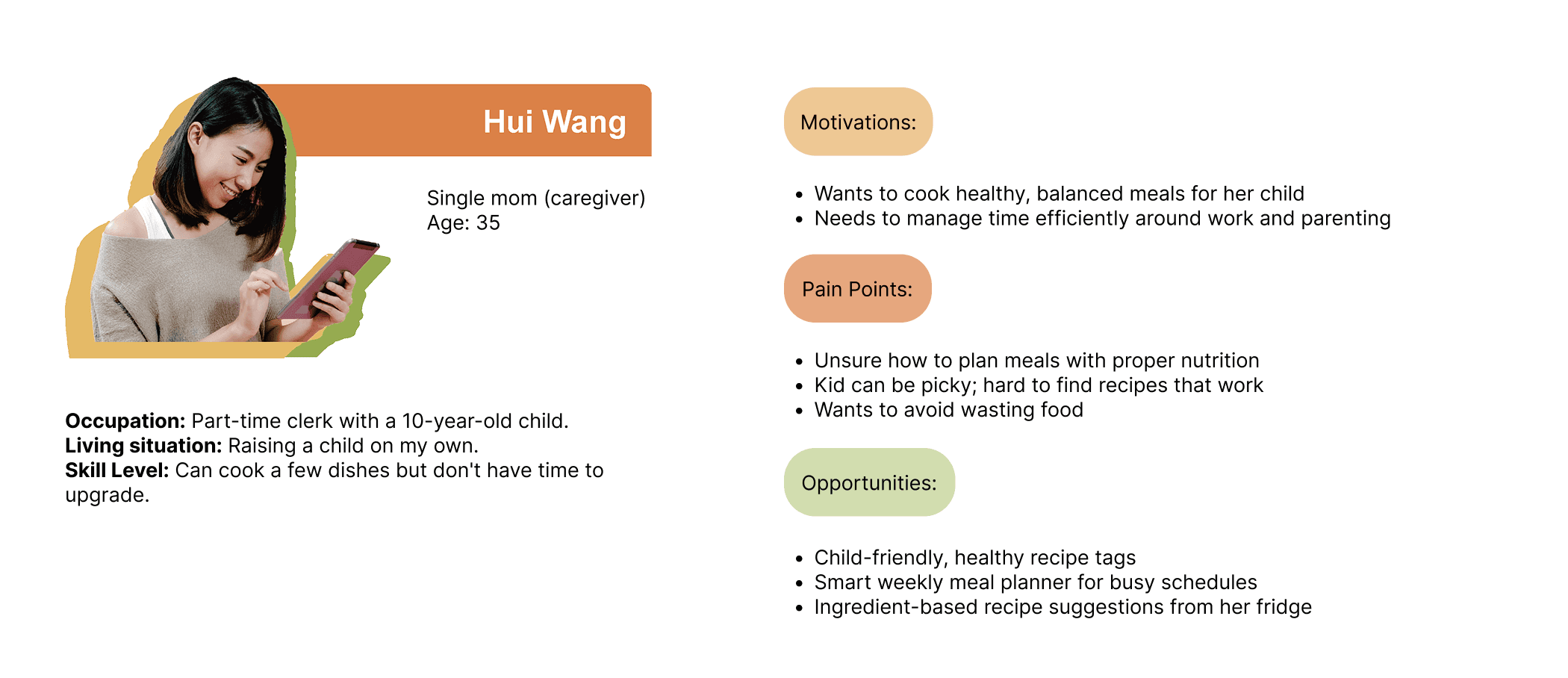
Representing time-constrained, motivation-driven home cooks, these personas anchor product decisions around reducing friction in everyday cooking.
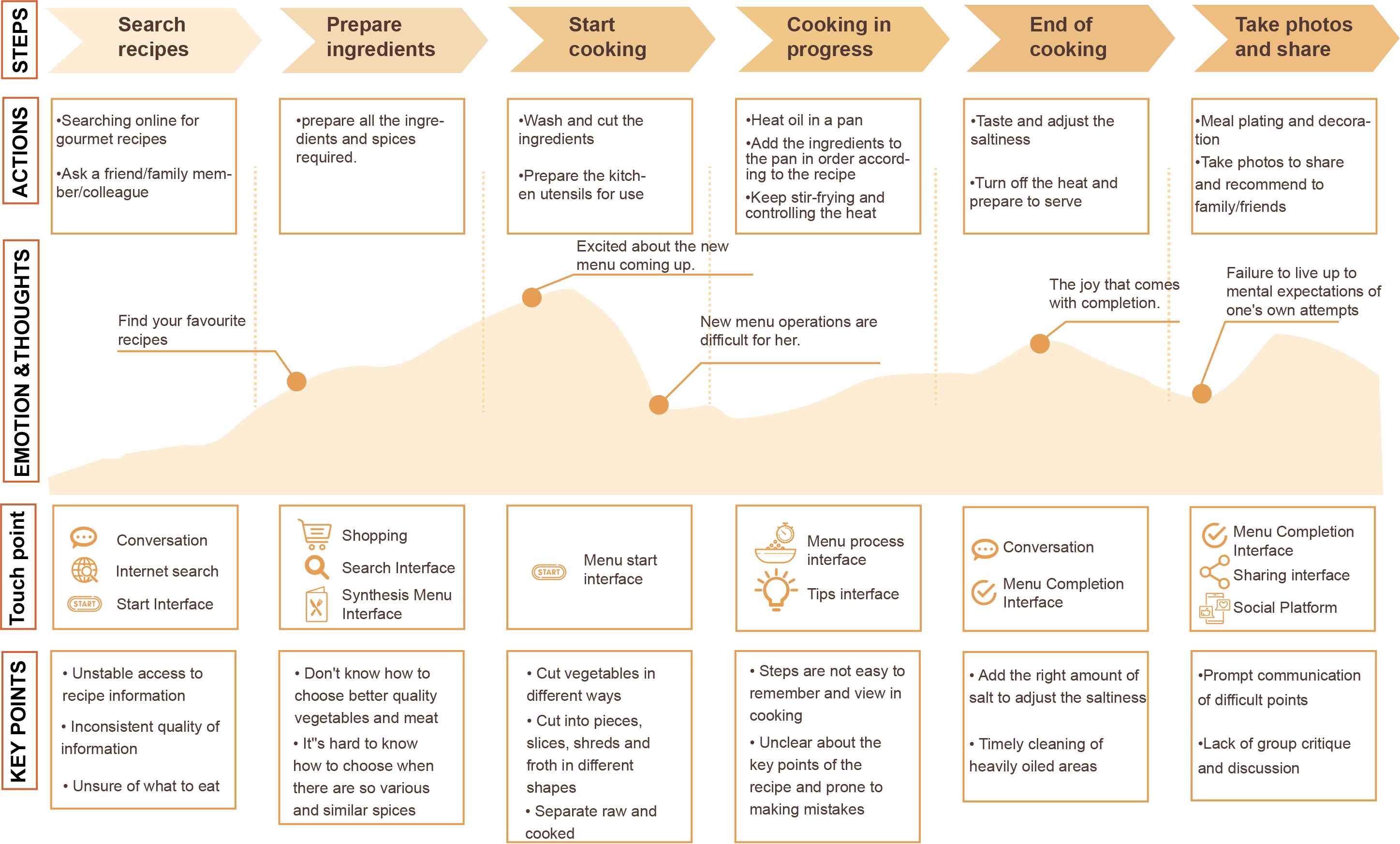
User Journey Map:
Finding:
This journey reveals that successful cooking experiences are less about culinary skill and more about managing uncertainty, memory load, and emotional confidence.
User behaviour:
Search &Prepare
Start cooking
Complete the dishes
•Recipe information should be extensive and professional.
•Food recommendations, ingredients to buy,recipes to match nutrition.
•Clear step-by-step information for easy memorisation and viewing.
•Key points are pointed out and difficult questions are asked and communicated.
•Point and click discussion
•Share results
Ideation:
Findings
Insights
Insights from user interviews
Approach for app design
Lack of Step-by-Step Guidance
Progressive Instruction Design
Voice-Activated Controls
AI-Powered Ingredient Matching
Gamified Cooking Experience
Hands-Busy Frustration
Ingredient Uncertainty
Lack of Encouragement
New cooks often felt overwhelmed by recipe formats, especially when too many steps were presented at once. This caused confusion, hesitation, and frequent backtracking during the cooking process.
Recipes were redesigned into a guided, one-step-at-a-time format with optional audio playback and timer controls, helping users stay focused and confident throughout the process.
Introduced simple voice commands like “next step,” “repeat,” and “set timer” to support hands-free navigation and reduce friction during the cooking experience.
Implemented an AI-based recommendation engine that suggests alternative ingredients or recipes based on what users already have at home, helping reduce waste and increase cooking confidence.
Introduced a lightweight reward system—badges for completed recipes, milestones for streaks, and encouraging messages—to support emotional motivation and build user confidence over time.
Users found it inconvenient to touch the screen with messy or wet hands while cooking, disrupting the flow and creating friction during recipe navigation.
Users were unsure how to substitute missing ingredients or how to use leftovers efficiently, which sometimes led them to abandon cooking altogether.
Some users expressed a lack of confidence and motivation, especially after failed attempts. Without feedback or a sense of progress, many gave up easily.
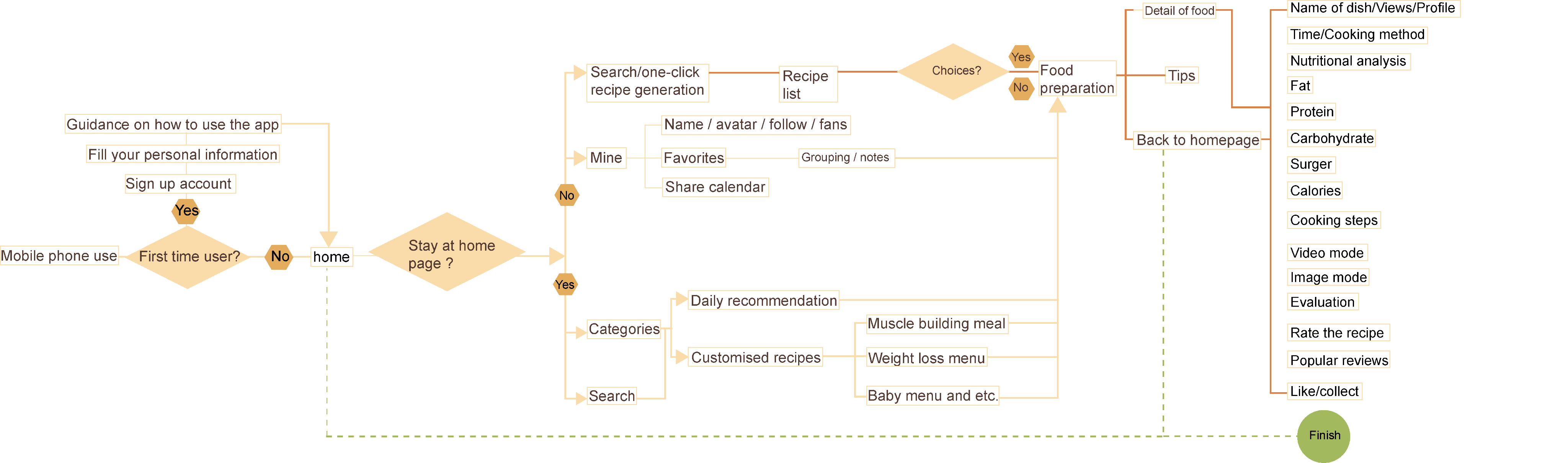
User flow:
User testing:
To understand whether LET’S COOK truly worked for real users, I ran two rounds of user testing with four participants in each round. Rather than focusing only on task completion, I wanted to uncover where people naturally hesitated, felt confused, or needed to pause and think — especially within our organic discovery flow.
During the sessions, I paid close attention to what participants said out loud, where they got stuck, and how confidently they moved through key tasks without guidance. These moments were often more revealing than success metrics alone. The feedback helped me see not just if the flow worked, but how users experienced it — highlighting moments of friction, uncertainty, and cognitive overload that weren’t obvious from the design itself.
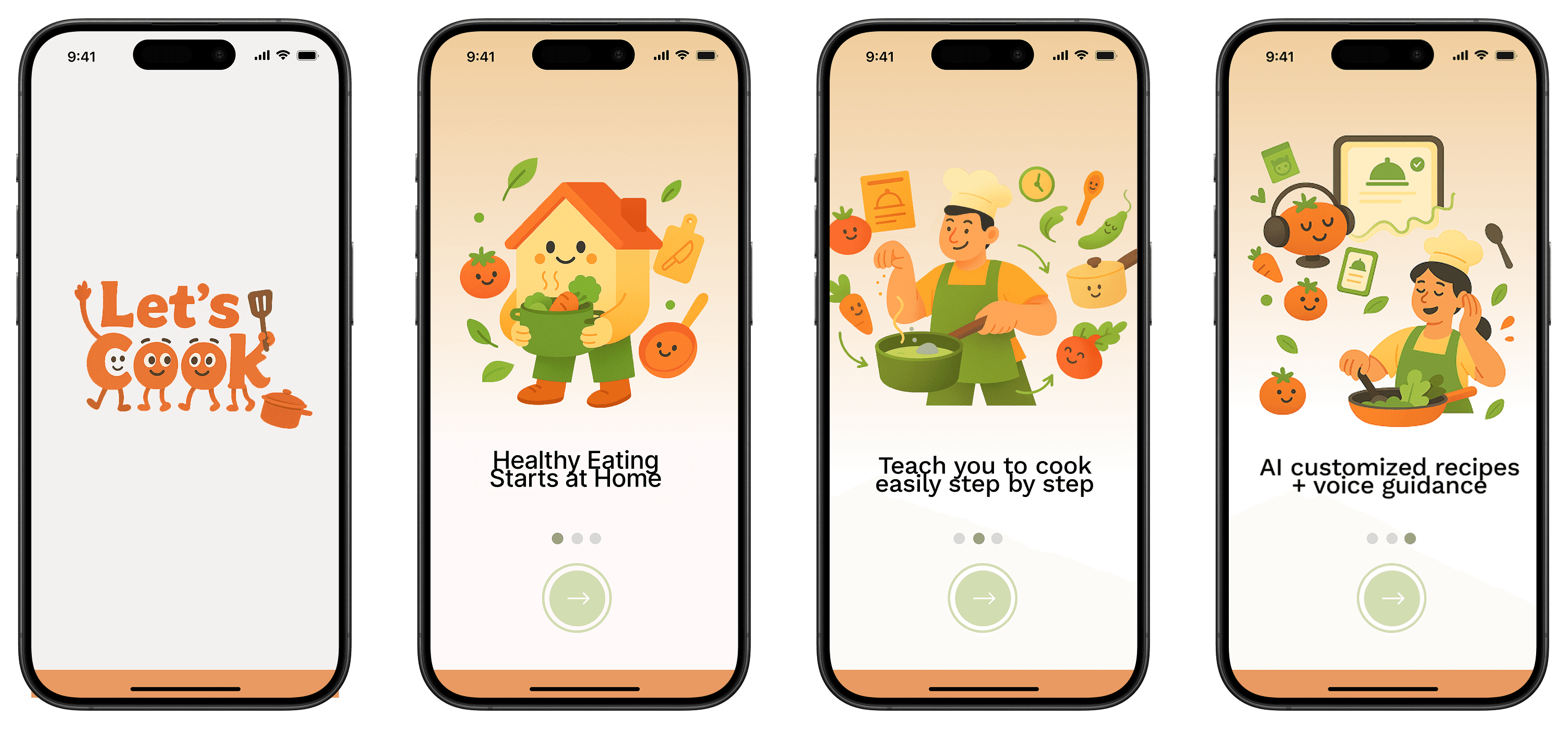
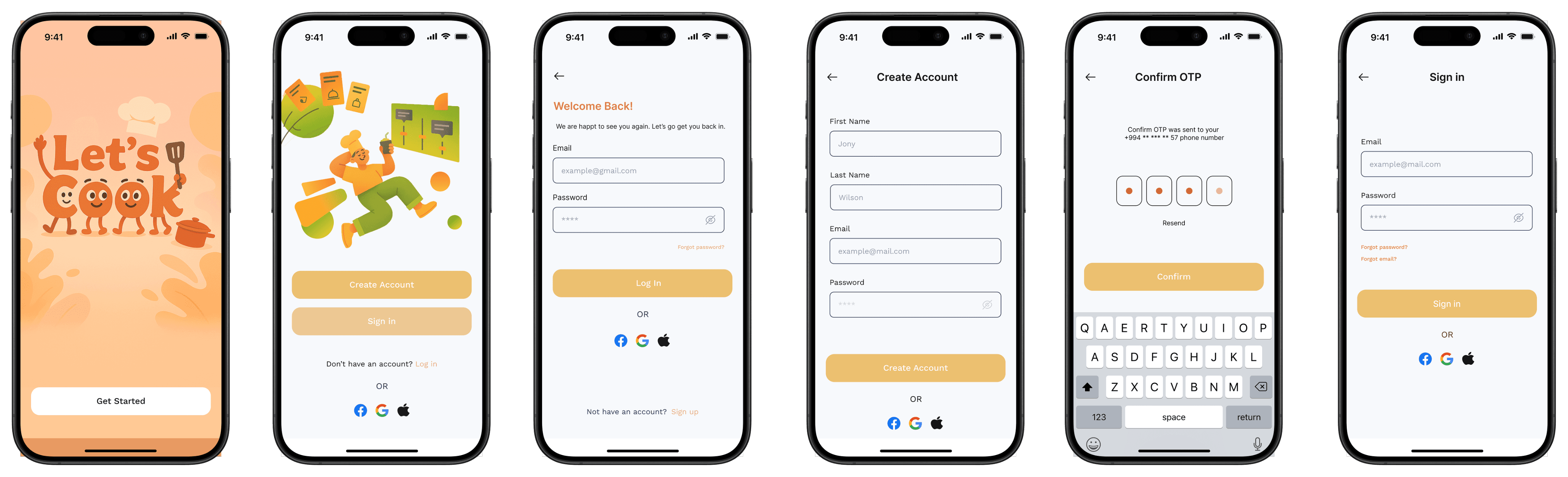
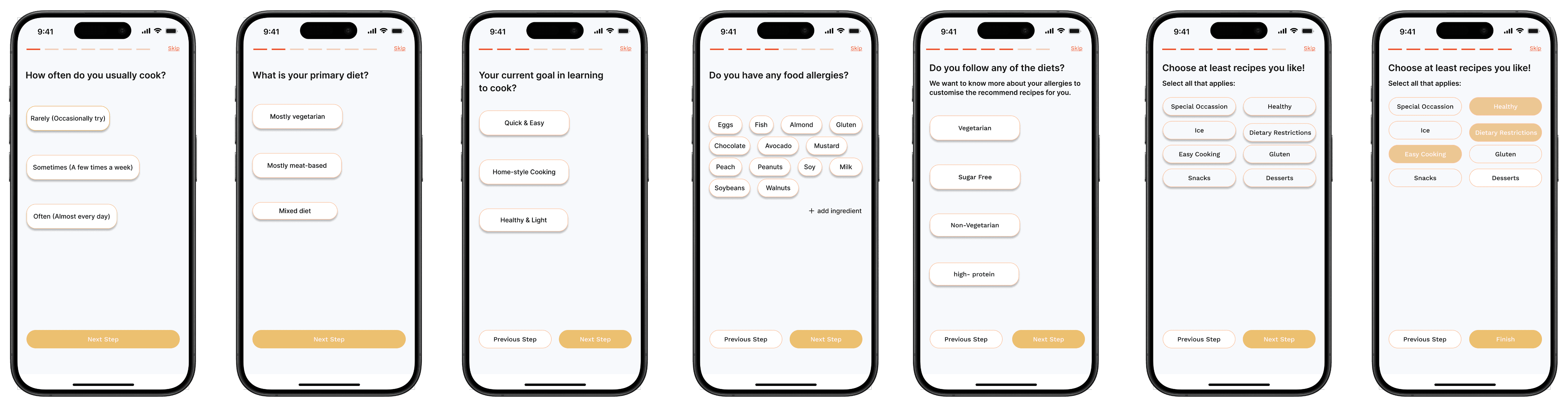
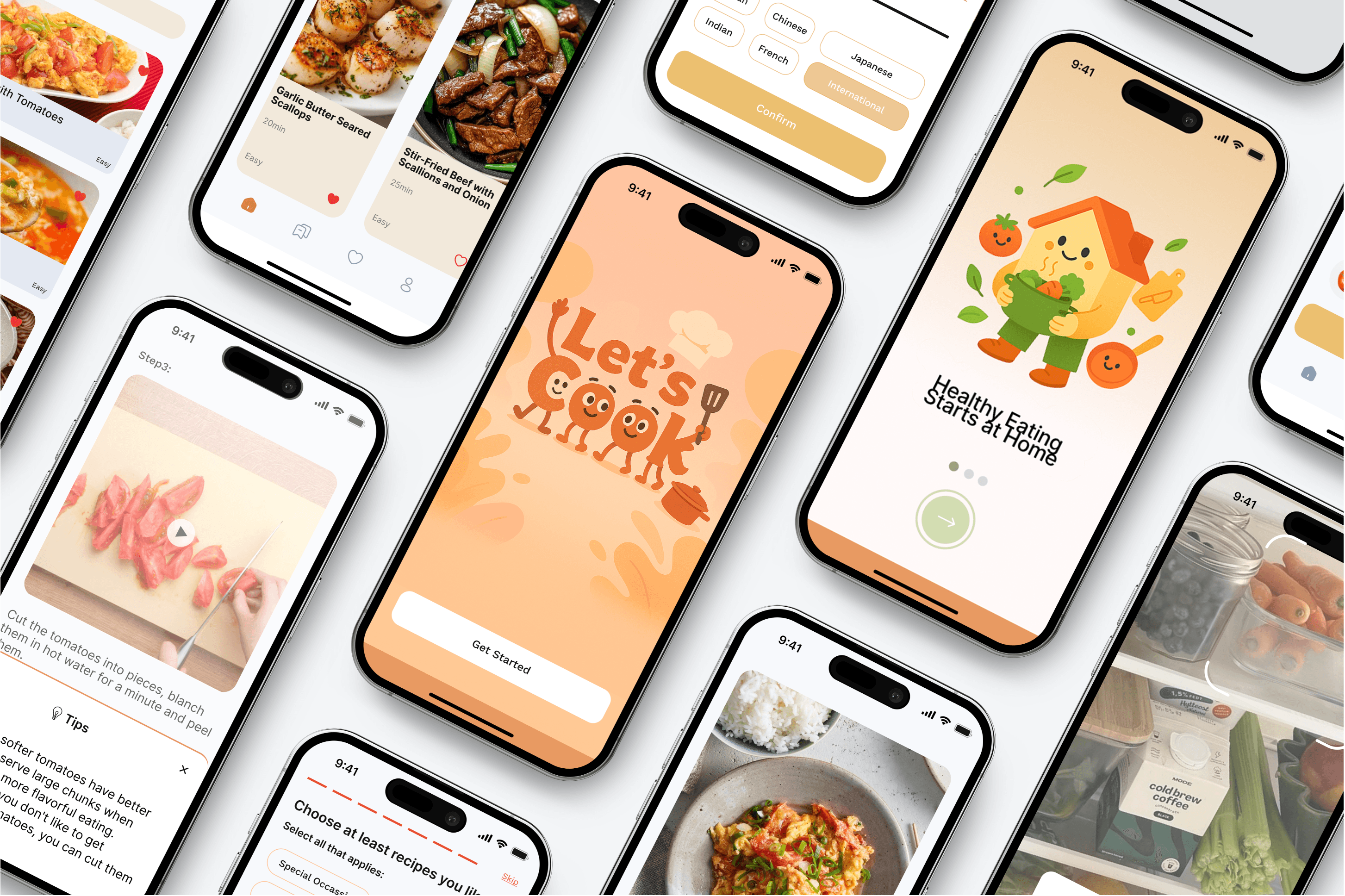
Onboarding page
User login page
Inquiries about eating habits
Navigation interface
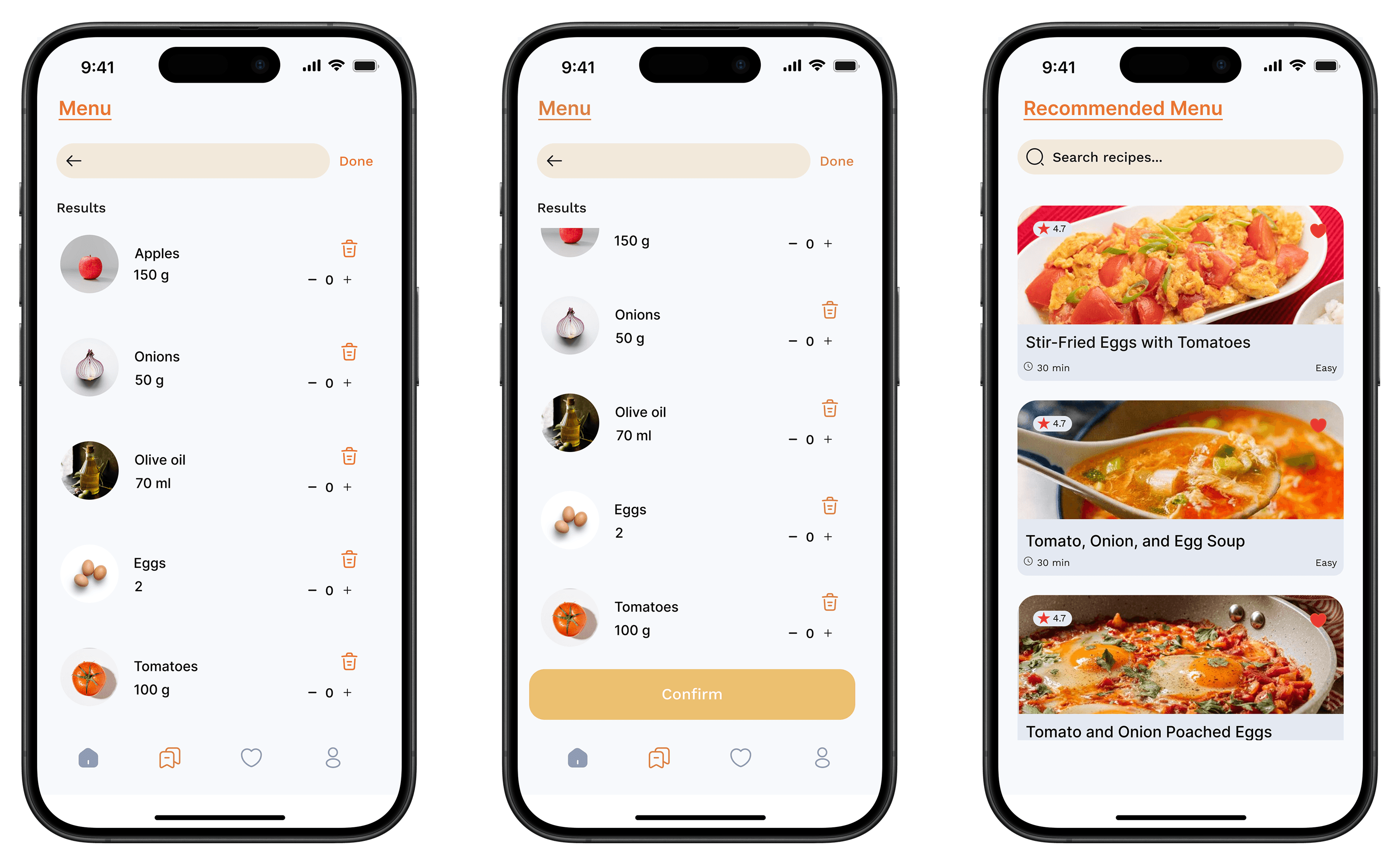
Users can type and scan for menu generation
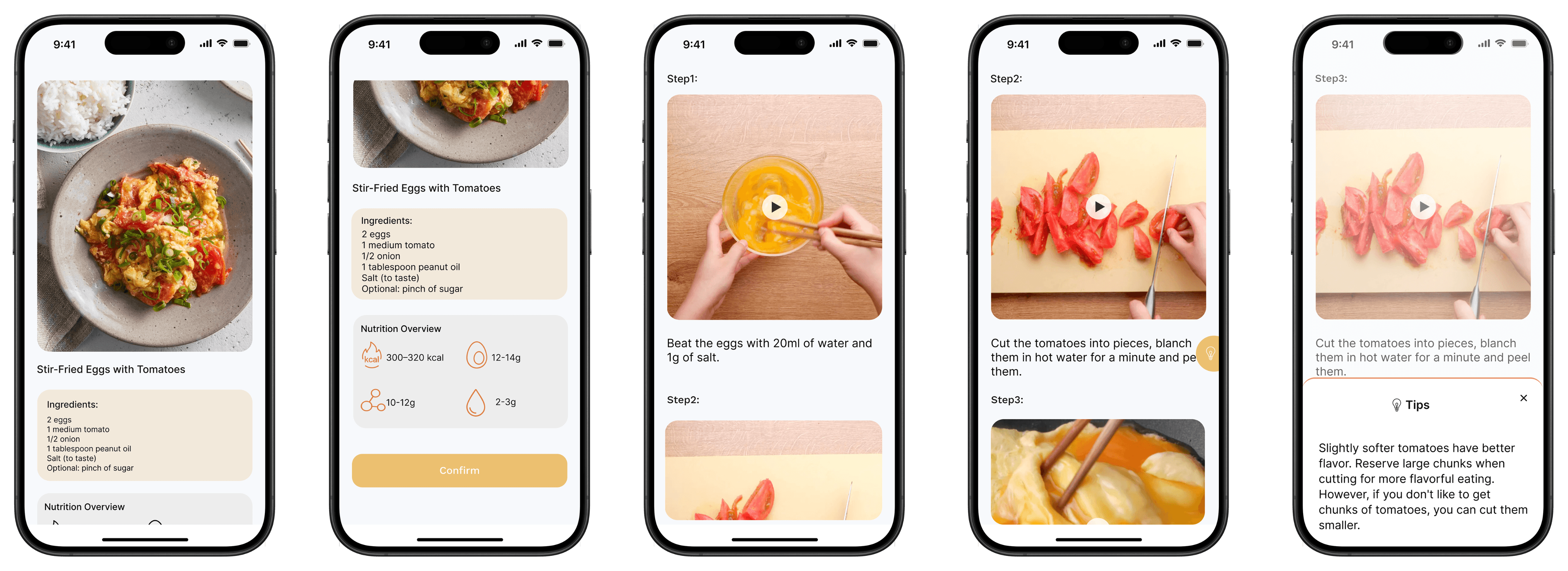
Teach Cooking interface
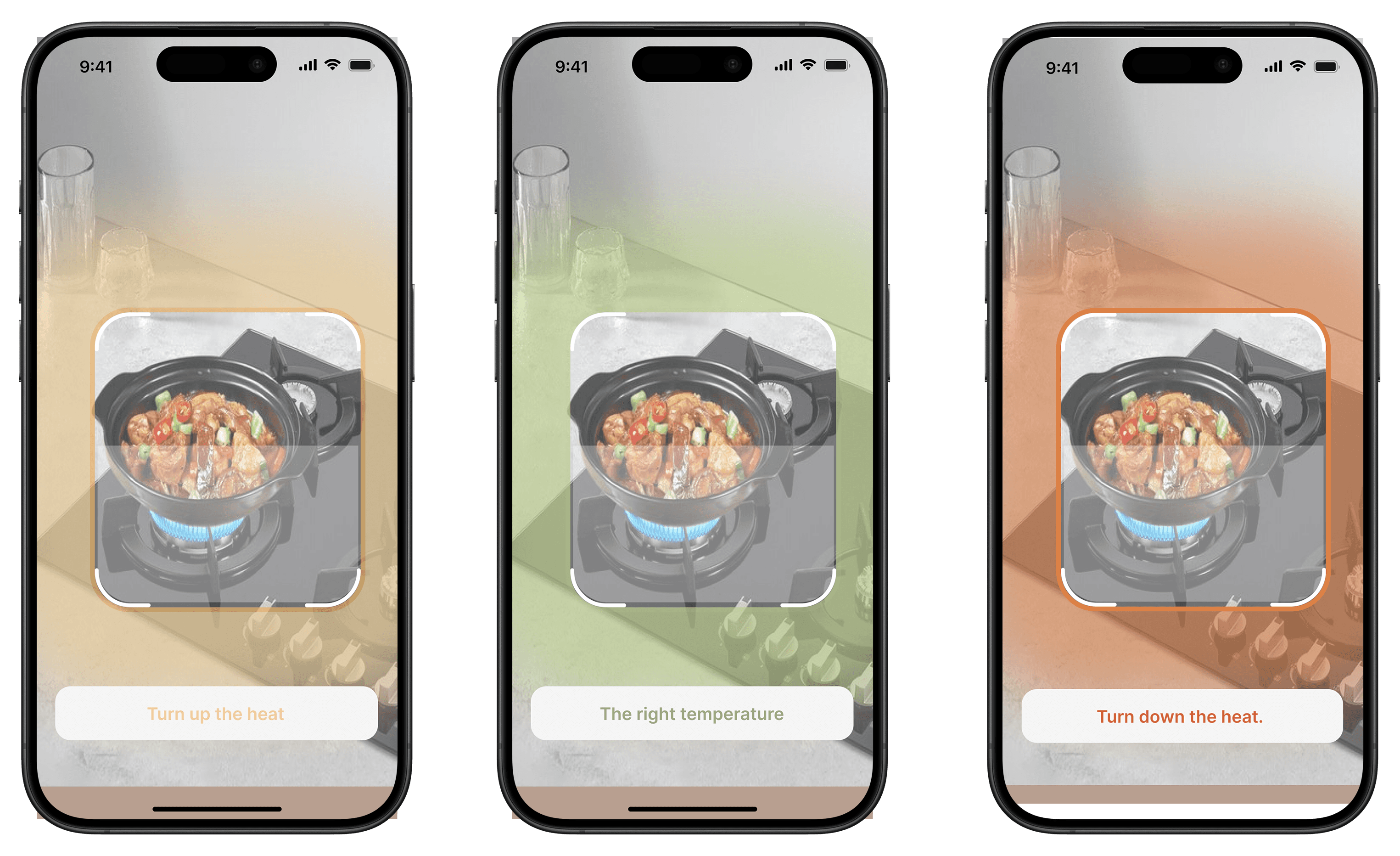
Heat level detection reminder
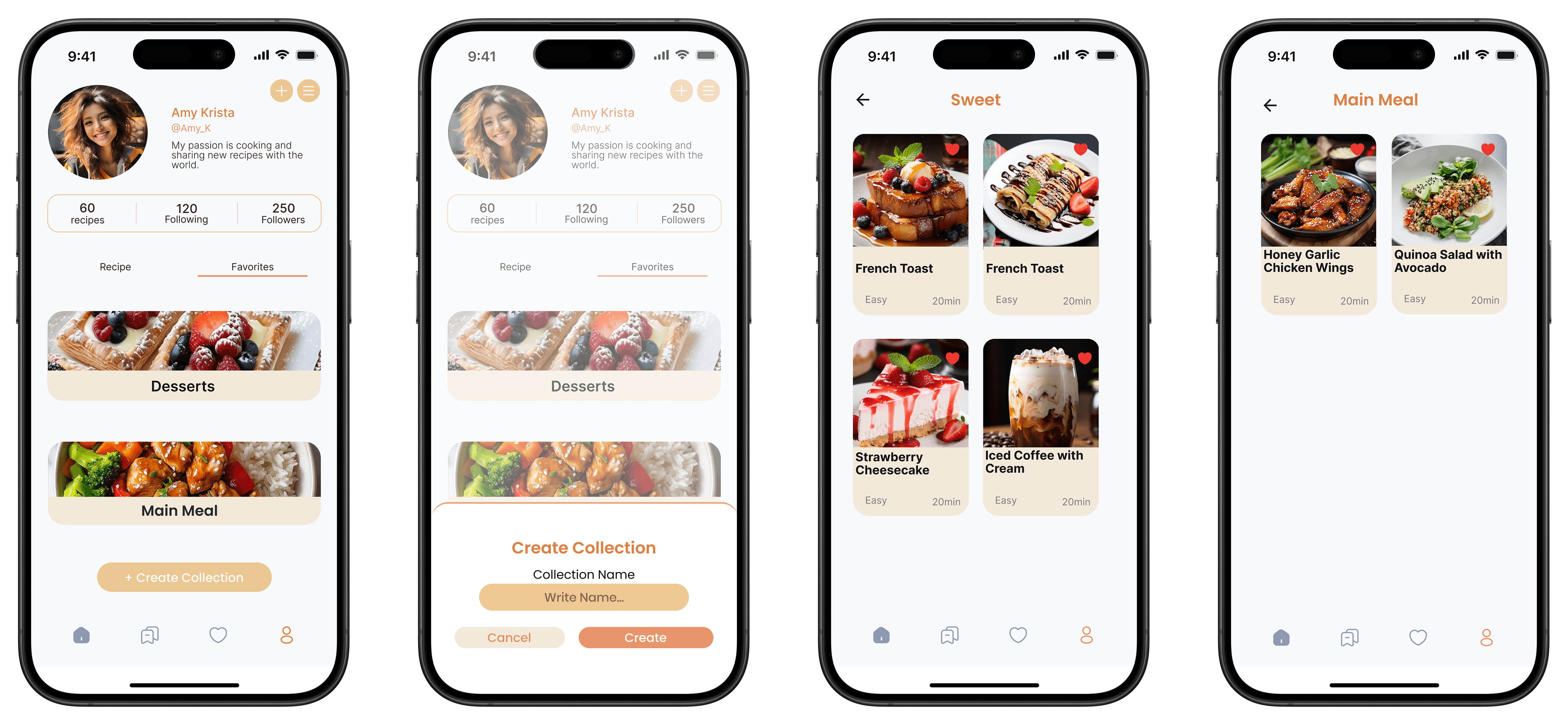
Personal page
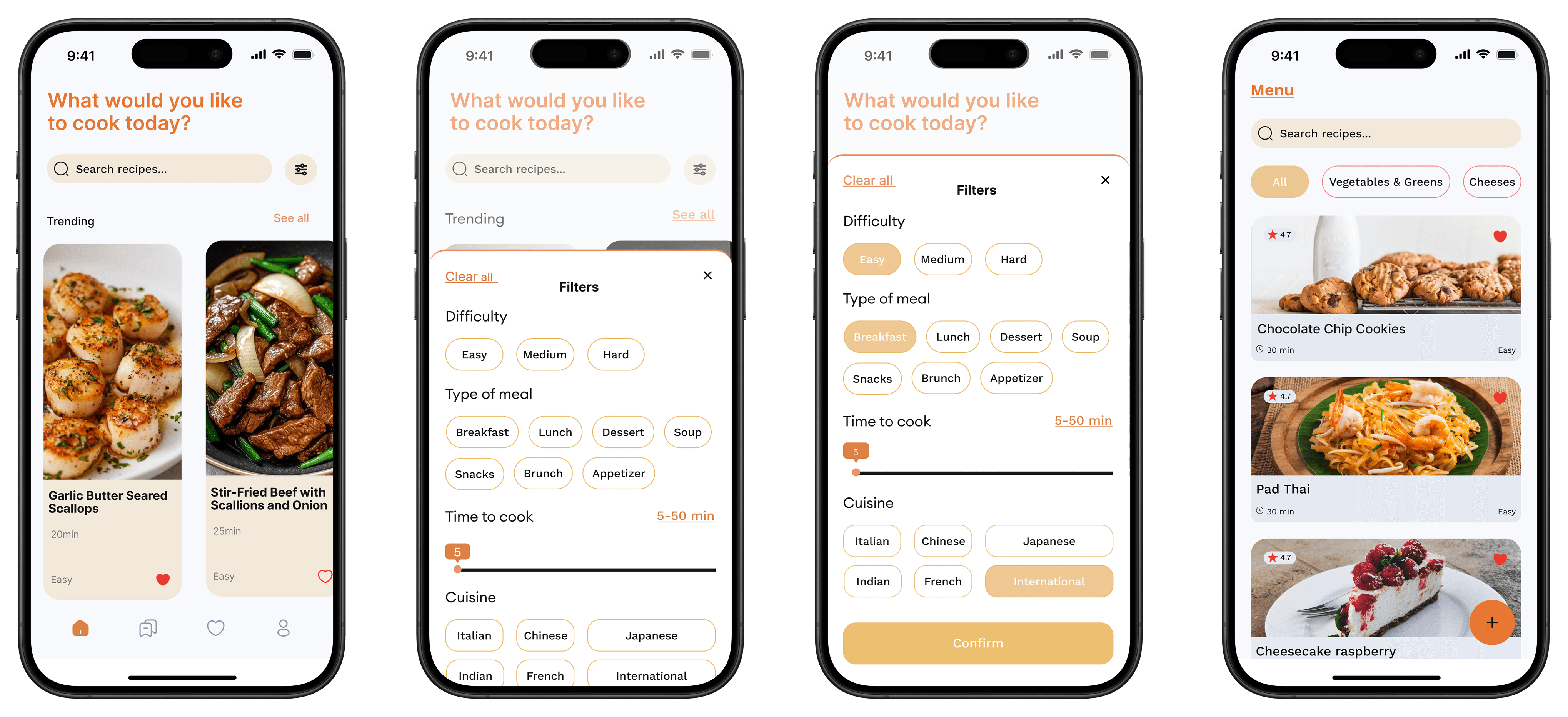
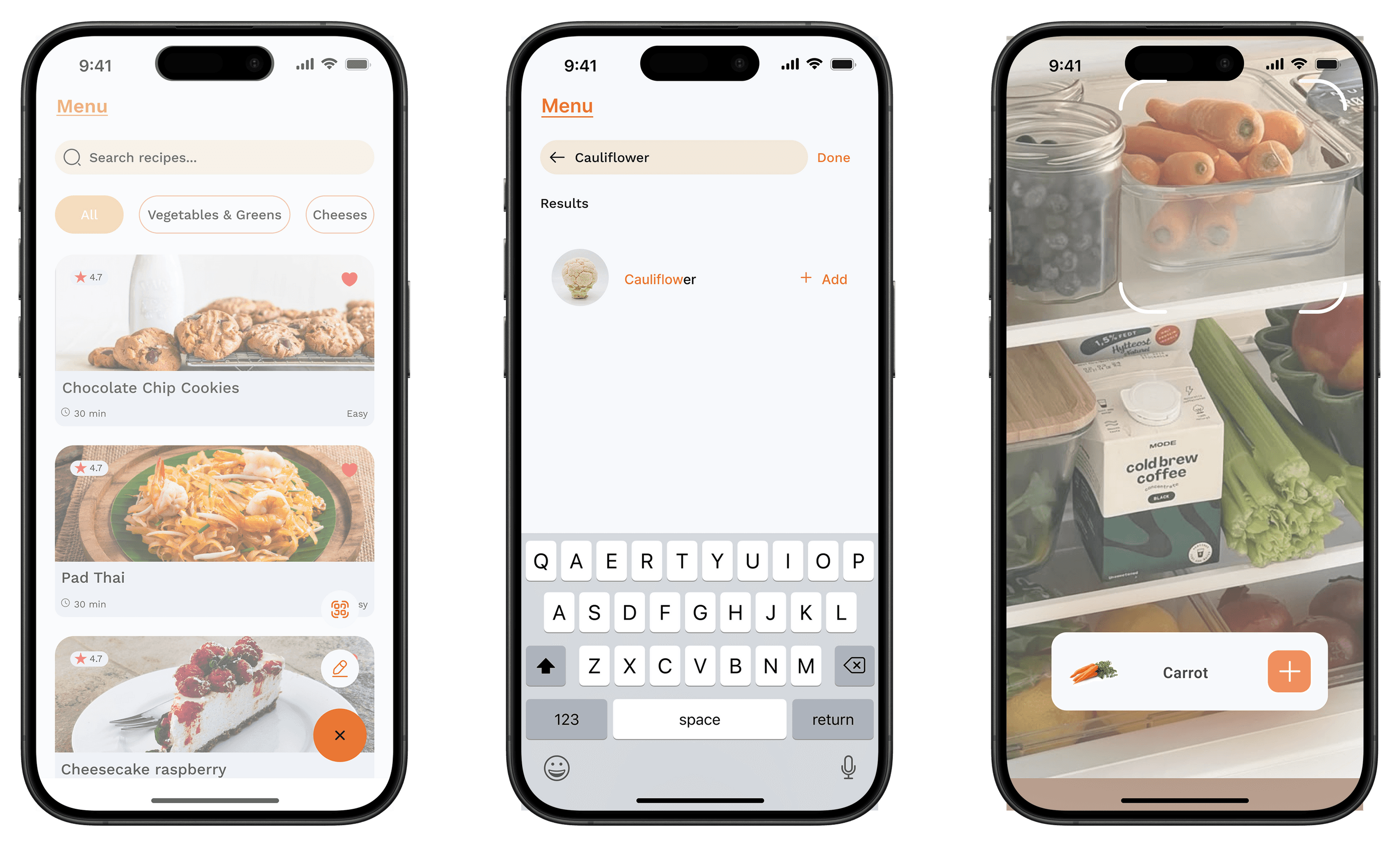
Interface Design:
More projects

LET'S COOK
Helps people who are new to cooking to solve the tedious problems of the cooking process.
Role
Product Designer
Duration
June 2023-October 2023
Tools
Figma, Illustrator
Research:
Insights Synthesis:
1. Cooking Is Becoming Younger and More Lifestyle-Driven
Cooking is no longer perceived purely as a way to save money or fulfill family obligations.
For younger users, it increasingly represents:
A form of health management
A way to regulate emotions and reduce stress
A daily ritual that adds meaning and structure to everyday life
2. Frequent but Not Heavy Users → Strong Dependence on Low Barriers
Cooking is no longer perceived purely as a way to save money or fulfill family obligations.
For younger users, it increasingly represents:
A form of health management
A way to regulate emotions and reduce stress
A daily ritual that adds meaning and structure to everyday life
3. Content Preference: Familiar Foods with Light Global Exploration
Users are not aiming for professional or chef-level cooking
Instead, their core question is:
“Can I finish this within 30 minutes tonight?”
User interview:
Timeline
1 week
The user interview process lasts for one week. During this time period, we were able to collect data from multiple user sessions, which allowed us to collect a variety of user interview results and question scenarios.
Sample Size
20 people
We interviewed 20 participants for the study from commuters living alone, college students, young couples, and new parents.
“Fear of doing it wrong and lack of confidence”
“The fire is not well controlled and you are not sure if you are doing it right.”
“Wondering what I can cook with these at home.”.
Approach
20 sessions
To evaluate core features—recipe steps, AI support, comments, and Q&A—I ran structured usability sessions combining live observation and interviews.
These helped surface key pain points, expectations, and emotional responses.
I also followed up with select users after extended use to gather deeper insights on long-term engagement.
Persona:
Representing time-constrained, motivation-driven home cooks, these personas anchor product decisions around reducing friction in everyday cooking.
User Journey Map:
Finding:
This journey reveals that successful cooking experiences are less about culinary skill and more about managing uncertainty, memory load, and emotional confidence.
User behaviour:
Search &Prepare
Start cooking
Complete the dishes
•Recipe information should be extensive and professional.
•Food recommendations, ingredients to buy,recipes to match nutrition.
•Clear step-by-step information for easy memorisation and viewing.
•Key points are pointed out and difficult questions are asked and communicated.
•Point and click discussion
•Share results
Ideation:
Findings
Insights
Insights from user interviews
Approach for app design
Lack of Step-by-Step Guidance
Progressive Instruction Design
Voice-Activated Controls
AI-Powered Ingredient Matching
Gamified Cooking Experience
Hands-Busy Frustration
Ingredient Uncertainty
Lack of Encouragement
New cooks often felt overwhelmed by recipe formats, especially when too many steps were presented at once. This caused confusion, hesitation, and frequent backtracking during the cooking process.
Recipes were redesigned into a guided, one-step-at-a-time format with optional audio playback and timer controls, helping users stay focused and confident throughout the process.
Introduced simple voice commands like “next step,” “repeat,” and “set timer” to support hands-free navigation and reduce friction during the cooking experience.
Implemented an AI-based recommendation engine that suggests alternative ingredients or recipes based on what users already have at home, helping reduce waste and increase cooking confidence.
Introduced a lightweight reward system—badges for completed recipes, milestones for streaks, and encouraging messages—to support emotional motivation and build user confidence over time.
Users found it inconvenient to touch the screen with messy or wet hands while cooking, disrupting the flow and creating friction during recipe navigation.
Users were unsure how to substitute missing ingredients or how to use leftovers efficiently, which sometimes led them to abandon cooking altogether.
Some users expressed a lack of confidence and motivation, especially after failed attempts. Without feedback or a sense of progress, many gave up easily.
User flow:
User testing:
To understand whether LET’S COOK truly worked for real users, I ran two rounds of user testing with four participants in each round. Rather than focusing only on task completion, I wanted to uncover where people naturally hesitated, felt confused, or needed to pause and think — especially within our organic discovery flow.
During the sessions, I paid close attention to what participants said out loud, where they got stuck, and how confidently they moved through key tasks without guidance. These moments were often more revealing than success metrics alone. The feedback helped me see not just if the flow worked, but how users experienced it — highlighting moments of friction, uncertainty, and cognitive overload that weren’t obvious from the design itself.
Onboarding page
User login page
Inquiries about eating habits
Navigation interface
Users can type and scan for menu generation
Teach Cooking interface
Heat level detection reminder
Personal page